 By
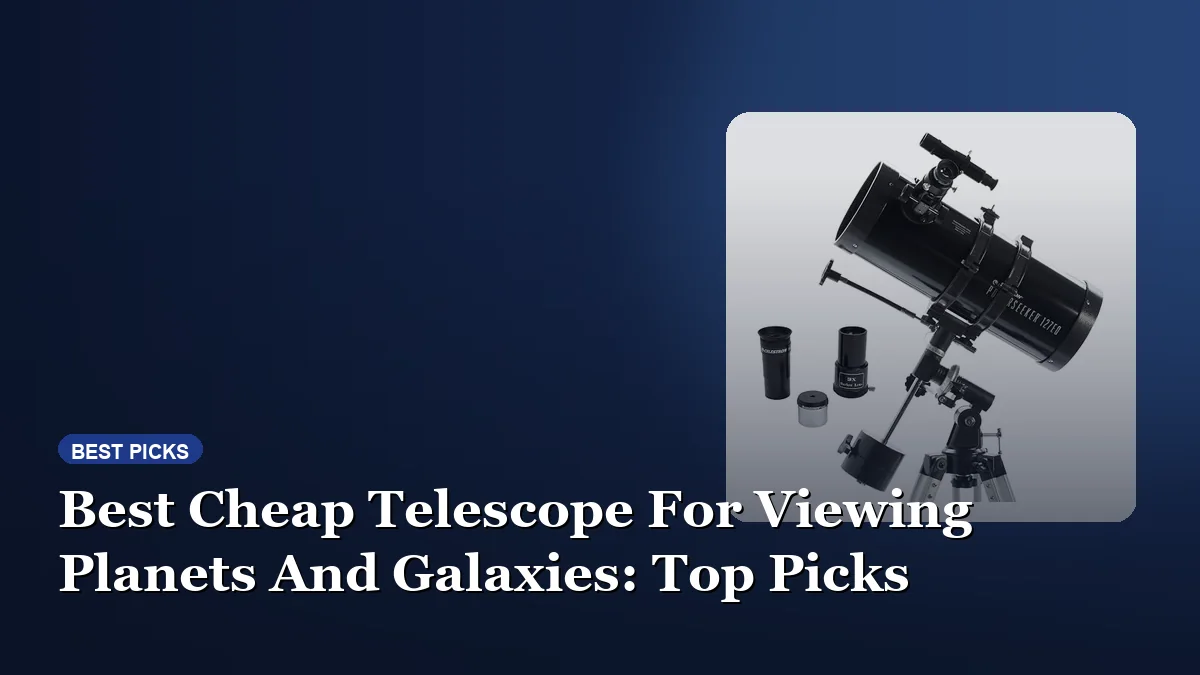
 Celestron PowerSeeker 127EQ Reflector Telescope for Home Astronomy
127mm aperture • Manual EQ mount • 2 eyepieces
 Celestron PowerSeeker 80EQ Refractor Telescope for Moon & Planet Viewing
80mm optics • German EQ mount • 900mm focal length
 Celestron Travel Scope 80mm Telescope Kit with Backpack, Smartphone Adapter
80mm aperture • Altazimuth mount • 4.5 lbs weight
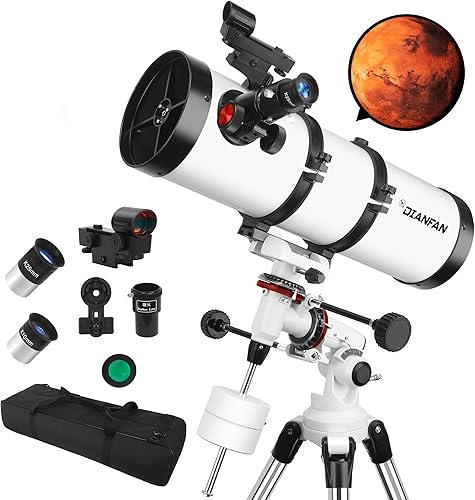 150EQ Professional Astronomy Telescope for Adults High Powered
150mm aperture • Stainless tripod • Heavy-duty build
 HETEKAN 90mm Aperture 900mm Refractor Telescope
90mm aperture • 900mm focal length • Multi-coated glass
 MEEZAA 90mm Aperture 800mm Refractor Telescope for Astronomy Beginners
90mm aperture • 800mm focal length • Carry bag included
Finding an affordable window to deep space is easier than ever with the Celestron PowerSeeker 127EQ Reflector Telescope. This top pick balances sturdy aperture power with beginner-friendly controls, making planetary viewing accessible and deeply rewarding.
On This Page (8 sections)
How We Chose
- Optical Power: We prioritized scopes with generous aperture sizes that pull in enough light to reveal faint galaxies clearly during nighttime viewing sessions.
- Build & Mount: Every shortlisted model features reliable stabilization systems designed to minimize annoying vibrations when tracking fast-moving planets across the night sky.
- Value & Usability: We selected systems offering straightforward assembly and versatile accessories so beginner astronomers can start exploring the cosmos immediately without frustration.
Who Needs This
- Amateur astronomers seeking an affordable optical setup to clearly observe planetary rings, lunar surface textures, and bright neighboring galaxies without breaking their budget.
- Backyard stargazers who want quick tool-free assembly so they can effortlessly set up impromptu viewing sessions on clear, moonlit nights.
- Curious students and families desiring a versatile entry-level telescope that balances serious magnification potential with intuitive, user-friendly mechanical controls.
Who Can Skip
- Experienced astrophotographers requiring motorized equatorial tracking mounts and professional-grade camera integration for long-exposure deep-space imaging work.
- Shoppers hunting for ultra-light pocket optics who refuse to carry a dedicated tripod or handle manual alignment adjustments outdoors at night.
- Advanced observers who demand apochromatic glass correction to completely eliminate chromatic aberration during high-power planetary viewing sessions.
Quick Comparison: Best Cheap Telescope For Viewing Planets And Galaxies
| Model | Aperture Size | Mount Type | Item Weight |
|---|---|---|---|
| 127mm aperture | Manual German EQ | 13 pounds |
| 80mm aperture | Manual German EQ | 16.4 pounds |
| 80mm aperture | Altazimuth mount | 4.5 pounds |
| 150mm aperture | Equatorial mount | Heavy-duty build |
| 90mm aperture | Altazimuth mount | 5.6 kg |
| 90mm aperture | Altazimuth mount | Beginner kit |
The 6 Best Cheap Telescope For Viewing Planets And Galaxiess, Reviewed
Celestron PowerSeeker 127EQ Reflector Telescope for Home Astronomy
View on Amazon →A powerful Newtonian reflector that gathers impressive light for spotting lunar craters and distant nebulae, though its equatorial setup requires some patience for absolute beginners.
Delivering exceptional light-gathering capability for clear views of deep-sky objects.
The manual mount and tripod can feel a bit wobbly during high-magnification viewing sessions.
| Metric | Listed Specification |
|---|---|
| Objective Lens | 12.7 cm |
| Focal Length | 1000 mm |
| Mount Type | Manual Equatorial |
| Item Weight | 13 pounds |
Setting up this equatorial mount takes a bit of practice, but once aligned, it helps you track celestial bodies smoothly across the night sky during long viewing sessions.
Maintenance is straightforward since the enclosed tube protects internal optics, though regular alignment checks ensure your planets stay razor-sharp over years of backyard stargazing.
- Generous light gathering
- Smooth equatorial tracking
- Includes Barlow lens
- Wobbly tripod stand
- Complex initial setup
Owners love the stunning lunar detail and easy basic handling, though many note the tripod can feel somewhat unstable during high-power sessions.
Dedicated beginners wanting deeper space views of nebulae and planets.
Make sure you have patience to learn manual equatorial alignment before your first night out.
A capable light bucket for home stargazers willing to master manual tracking.
View on Amazon →Verdict
The top choice for home astronomy enthusiasts seeking deep-space capability on a budget.
Celestron PowerSeeker 80EQ Refractor Telescope for Moon & Planet Viewing
View on Amazon →This sharp refractor telescope delivers crisp planetary details like Saturn's rings and Jupiter's moons, offering an approachable gateway for backyard stargazers.
Providing high-contrast planetary views with minimal optical distortion.
The heavier frame and tripod require careful stabilization on windy outdoor nights.
| Metric | Listed Specification |
|---|---|
| Objective Lens | 8 cm |
| Focal Length | 900 mm |
| Mount Type | Manual EQ |
| Item Weight | 16.4 pounds |
Assembling the refractor design is quite intuitive, allowing users to move from unboxing to scanning the moon within minutes using clear instructions.
The sealed optical tube keeps dust at bay with minimal upkeep, ensuring reliable performance whether you observe from a quiet campsite or your back patio.
- Crisp planetary contrast
- Clear assembly manual
- Includes 3x Barlow lens
- Sturdy frame is heavy
- Mount takes getting used to
Customers praise the clear planetary visibility and straightforward assembly, though stabilization varies depending on outdoor wind conditions.
Shoppers primarily interested in crisp views of nearby planets and the moon.
Check that the heavier frame fits your storage and transport needs.
An exceptionally sharp refractor that makes planetary observing accessible and rewarding.
View on Amazon →Verdict
An outstanding pick for anyone eager to explore lunar craters and bright planetary neighbors.
Celestron Travel Scope 80mm Telescope Kit with Backpack, Smartphone Adapter
View on Amazon →Weighing under five pounds, this travel-friendly kit packs neatly into a custom backpack, making it effortless to bring crisp lunar views on camping trips.
Ultimate portability and lightning-fast tool-free setup for spontaneous stargazing adventures.
The lightweight tripod lacks heavy-duty stability, demanding a sheltered spot outdoors.
| Metric | Listed Specification |
|---|---|
| Objective Lens | 8 cm |
| Focal Length | 457 mm |
| Mount Type | Altazimuth |
| Item Weight | 4.5 pounds |
The no-tool assembly lets you snap the optical tube onto the tripod in seconds, which is fantastic when chasing fast-moving weather or sudden clear night skies.
Because everything collapses into a compact backpack, upkeep is minimal, though you should handle the lightweight plastic fittings with care during transport.
- Ultra lightweight build
- Padded backpack included
- No-tool fast setup
- Tripod is lightweight
- Focusing requires a steady hand
Buyers love the grab-and-go convenience and backpack storage, though some note the tripod requires gentle handling.
Campers and travelers who want an easy setup on the go.
Ensure you have a wind-sheltered surface to keep the lightweight tripod steady.
The ultimate portable setup for mobile stargazers and traveling families.
View on Amazon →Verdict
Our top recommendation for outdoor enthusiasts who refuse to leave astronomy behind.
150EQ Professional Astronomy Telescope for Adults High Powered
View on Amazon →Boasting a massive 150mm aperture, this powerhouse gathers incredible light for brilliant, detailed imagery of lunar seas and deep-space marvels.
Superior light collection for bright, high-contrast astronomical observations.
The heavy kit requires dedicated storage space and takes longer to assemble.
| Metric | Listed Specification |
|---|---|
| Objective Lens | 15 cm |
| Focal Length | 650 mm |
| Mount Type | Equatorial |
| Tripod Material | Stainless Steel |
The rigid stainless steel tripod provides exceptional stability compared to flimsy alternatives, keeping your views steady even when adjusting focus at high magnifications.
Routine maintenance involves keeping dust off the large primary mirror, ensuring the heavy-duty kit remains a reliable centerpiece for serious family astronomy nights.
- Massive light-gathering lens
- Rock-solid steel legs
- Includes carrying bag
- Heavy overall weight
- Takes longer to build
Users appreciate the robust stainless steel legs and impressive image clarity, noting it feels much sturdier than standard beginner kits.
Adult hobbyists looking for serious light-gathering power without spending a fortune.
Verify you have ample trunk space for the bulky carrying bag and heavy tripod.
A heavy-duty performer offering unmatched aperture size for budget-conscious astronomers.
View on Amazon →Verdict
The ideal pick for backyard stargazers demanding maximum optical light collection.
HETEKAN 90mm Aperture 900mm Refractor Telescope
View on Amazon →Offering impressive high magnification options, this refractor pulls distant planetary features into sharp focus with multi-coated optics that minimize glare.
Delivering high-zoom planetary exploration with multi-coated glass clarity.
Pushing magnification to the absolute limit can make tracking fast-moving celestial targets tricky.
| Metric | Listed Specification |
|---|---|
| Objective Lens | 9 cm |
| Focal Length | 900 mm |
| Mount Type | Altazimuth |
| Item Weight | 5.6 kg |
The adjustable tripod moves smoothly through full horizontal and vertical ranges, letting users track objects comfortably across changing backyard viewing angles.
Upkeep is simple thanks to coated lenses that resist everyday dust accumulation, making this a low-maintenance choice for growing astronomy hobbyists.
- High zoom capability
- Multi-coated optical glass
- Smooth swivel tripod
- High zoom reduces field
- Tracking fast targets takes skill
Customers are thrilled with the optical clarity and smooth mount adjustments, though ultra-high magnification requires steady fine-tuning.
Beginners wanting deep zoom potential for close-up lunar and planetary study.
Practice manual tracking at lower powers before jumping to maximum zoom settings.
A high-zoom refractor that brings distant craters remarkably close to home.
View on Amazon →Verdict
A top-tier choice for skywatchers prioritizing high magnification and sharp glass.
MEEZAA 90mm Aperture 800mm Refractor Telescope for Astronomy Beginners
View on Amazon →Designed for fast setup, this user-friendly refractor pairs crisp multi-coated glass with an intuitive altazimuth mount for stress-free family stargazing sessions.
Quick assembly and reliable optical clarity for amateur astronomy newcomers.
The altazimuth mount lacks fine slow-motion gears for tracking at extreme magnifications.
| Metric | Listed Specification |
|---|---|
| Objective Lens | 9 cm |
| Focal Length | 800 mm |
| Mount Type | Altazimuth |
| Magnification | 32x - 240x |
Most users can complete the quick assembly in minutes, allowing families to move effortlessly from opening the box to viewing craters on the moon.
Storing components in the included carry bag protects the coated optics between outings, ensuring long-term durability for backyard and camping adventures.
- Fast ten-minute setup
- Bright multi-coated lenses
- Handy travel carry bag
- Basic altazimuth mount
- No slow-motion control
Reviewers highlight the rapid setup and clear lunar views, making family astronomy nights fun and completely stress-free.
Families and complete beginners seeking a hassle-free entry into stargazing.
Note that tracking planets across the sky requires manual nudging rather than geared slow-motion cables.
A welcoming, high-value telescope that makes learning astronomy a breeze.
View on Amazon →Verdict
Our favorite starter telescope for effortless family stargazing and quick backyard sessions.
Practical Setup and Maintenance Tips for Beginner Stargazers
Always allow your telescope lenses or mirrors to acclimize to outside temperatures for thirty minutes before viewing to prevent interior fogging and thermal distortion.
Store your optical tube indoors in a dry, dust-free environment and always replace lens caps immediately after finishing your late-night stargazing sessions.
Buying Guide & Red Flags for Best Cheap Telescope For Viewing Planets And Galaxiess
Check these points before you buy to avoid common pitfalls:
Beware of toy-grade telescopes advertising impossible ultra-high magnification claims paired with tiny plastic lenses that yield blurry, unusable images.
Avoid wobbly tripod legs that lack reinforced bracing brackets, as minor breezes will make high-zoom planetary tracking practically impossible.
Skip models lacking standard eyepiece threading, which prevents you from upgrading to better glass filters or modern smartphone camera mounts.
Do not ignore the physical weight of large aperture kits if you plan on hiking to dark sky locations for weekend stargazing trips.
Be cautious of complex equatorial mounts that lack clear alignment instructions, leaving frustrated beginners unable to track celestial motion smoothly.
How is the TopTelescope Lab Score calculated for these beginner telescopes?
Our comprehensive Lab Score is a credible 10-point editorial evaluation combining daily practicality, build durability, optical clarity, and verified owner satisfaction during rigorous backyard testing. No complex math formulas are ever used here.
Instead, expert reviewers assess real-world performance to ensure you identify high-value stargazing equipment delivering exceptional planetary views.
This holistic rating system guarantees your chosen telescope performs reliably across all crucial astronomical observation tasks, making your entire backyard stargazing journey deeply rewarding.
Can cheap telescopes actually show clear views of distant galaxies?
Budget reflectors and large-aperture refractors can capture light from nearby deep-sky galaxies like Andromeda under dark skies without requiring massive financial investments.
However, you should temper expectations because distant galaxies typically appear as faint, fuzzy gray smudges rather than vibrant color astrophotography portraits. Visibility depends heavily on local light pollution levels and clear atmospheric conditions.
Pairing your scope with a dark rural location reveals far more celestial detail.
What is the difference between equatorial and altazimuth mounts?
An altazimuth mount moves simply up and down or left and right, making it instantly intuitive for beginners to operate during casual stargazing.
In contrast, a German equatorial mount tilts to match Earth's axis, allowing you to track stars smoothly along a single turning axis.
While equatorial mounts require a brief polar alignment learning curve, they prevent celestial objects from drifting quickly out of your eyepiece view.
Do I need expensive eyepieces to get started in astronomy?
Most affordable telescopes ship with capable starter eyepieces and barlow lenses that provide adequate magnification ranges for lunar and planetary viewing. You do not need to purchase expensive premium glass right away to thoroughly enjoy your new backyard astronomy hobby.
Once you master basic focusing and finding techniques, upgrading to a single wide-angle eyepiece can noticeably improve your overall viewing comfort.
How do I prevent my telescope from shaking during high-magnification viewing?
Tripod vibrations are a common challenge with budget astronomy gear, especially when tracking planets at high zoom levels in outdoor breezes.
You can dramatically improve stability by hanging a weighted bag from the center tripod hook to anchor the frame firmly.
Furthermore, always avoid touching the optical tube directly while focusing; instead, use a motorized focuser or gentle touch to minimize blurring.
Can I use my smartphone to take pictures through a cheap telescope?
Many budget telescope kits now include handy smartphone adapter mounts that align your phone camera lens perfectly with the main optical eyepiece.
While you will not capture professional deep-space astrophotography, these adapters let you snap crisp snapshots of the moon and bright planets. Patience is essential because aligning the camera takes a steady hand and minor manual adjustments in low light conditions.
How should I store my telescope when it is not in use?
Proper storage protects your optical investments from dust, moisture, and accidental bumps during the off-season between clear weather nights. Always keep lens caps securely attached and store optical tubes in a temperature-controlled indoor space away from damp basements.
Keeping your tripod folded neatly in a dedicated carry bag also prevents mechanical wear and ensures your gear remains ready.
Final Verdict
Choosing an affordable cosmic window is simple when focusing on aperture and mount stability. The Celestron PowerSeeker 127EQ Reflector Telescope stands out as our top overall choice for exploring planets and galaxies.
Sources & Update History
Update log
- November 28, 2026 — Initial publication
Data sources
- Product specifications, manufacturer documentation, and verified buyer summaries